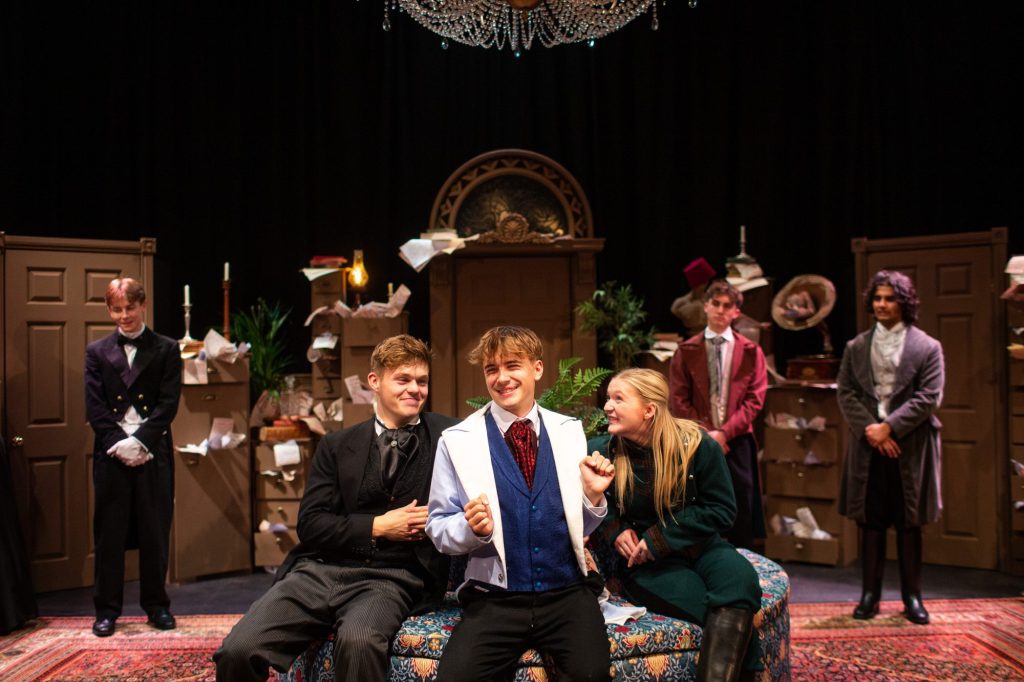
Bedford Modern School: The Government Inspector – A Masterclass in Ensemble Comedy
As an NSTA representative, I had the pleasure of visiting The Place Theatre, Bedford on Friday 7th November 2025 to watch Bedford Modern School’s vibrant and thoroughly engaging production of Nikolai Gogol’s The Government Inspector. Performing the 2011 David Harrower adaptation, from the first moments, the performance demonstrated meticulous attention to pace, style, and comic timing, immediately drawing the audience into the chaos, corruption, and farcical energy of this satirical Russian classic.
The direction of the play by Shelley Leather was highly effective, ensuring that comic timing, characterisation, and use of space reinforced both the narrative and the classic comic style of Gogol’s original text. The production successfully balanced faithful adherence to Gogol’s satirical intentions with contemporary theatrical conventions, ensuring relevance for a twenty-first-century audience. The integration of modern references, carefully considered vocal choices, and dynamic physicality brought the characters vividly to life while maintaining clarity of plot, theme, and comic rhythm. The ensemble’s awareness, timing, and mutual support allowed the narrative to flow seamlessly, while audience engagement was clearly maintained, evidenced by raucous laughter during the climactic scenes.
The set design was particularly noteworthy, with three upstage doors and a central banquette allowing seamless scene transitions and enabling action to unfold across multiple levels of the stage. The choice of period-appropriate furnishings, painted in muted brown tones, combined with an ornate central chandelier and florally decorated banquette, successfully evoked the opulence and chaos of the Mayor’s household while remaining non-distracting, allowing the actors’ performances to remain the focus. The intimate, end-on stage of The Place was utilised cleverly, with the upstage area housing cabinets and drawers overflowing with paperwork, reinforcing the disorder and corruption central to the narrative. Stage management by Hattie and Samir ensured that these transitions and the movement of modular set pieces were executed smoothly, maintaining the pace and energy of the performance without disrupting the flow. The lighting, though simple, was effective, while the carefully chosen contemporary and traditional Russian music underscored key moments, and the slow-motion final tableau amplified the comic character reactions in the closing moments.
Every cast member contributed to a carefully calibrated comic flow, supporting the lead roles while maintaining individual character integrity, though some cast members demand special mention here. Ed, playing the Mayor, delivered a commanding performance, his stage presence reinforced by expressive pacing, exaggerated gestures, and controlled use of physicality to communicate both authority and underlying ineptitude. His vocal work, including high-register laughter and well-timed fluctuations in pitch, combined with facial expressions of frustration, condescension, and disbelief, to create a character simultaneously powerful, ridiculous, and entirely consistent with Gogol’s critique of bureaucratic corruption. His physicality, particularly when overwhelmed by the perceived incompetency of those around him, enhanced the irony of his ineptitude while reinforcing comic effect.
Benji, portraying Khlestakov, was equally compelling. His urbane, measured presence in front of those he sought to manipulate provided a sharp contrast to the frenetic energy of the Mayor and ensemble, emphasising the cad’s manipulative arrogance and intense need for admiration and control. Behind the scenes and in his closing monologue of the first act, he became chaotic and frenetic, his occasional breathlessness and strained projection instantly conveying both character and underlying desperation. The monologue was a particular highlight, brilliantly showcasing his greed and culminating in a hilariously precise and impressive collapse into the ensemble.
Bodh’s Osip was a brilliant counterpoint to Khlestakov’s restless energy, offering calm precision and subtle humour throughout. His measured pace, controlled stillness, and perfectly timed reactions (often subtle yet effective!) grounded the surrounding chaos and highlighted his character’s quiet intelligence. There was a wonderful dryness to his delivery, particularly in his muttered asides and understated glances, which drew consistent laughter without ever breaking the rhythm of the scene. His presence gave balance to the farce, reinforcing the absurdity of his master’s behaviour while ensuring that the humour remained sharp, detailed, and truthful.
The ensemble work was particularly strong, reflecting both technical precision and a deep understanding of comic dynamics. From the outset, a series of rapid-fire vignettes introduced the characters, establishing their relationships, status, and personalities with clarity and style. These initial entrances and exits demonstrated excellent timing, with actors creating brief, highly effective character moments that set the pace and tone for the remainder of the performance. The ensemble’s cohesion extended beyond the actors to include the technical team, whose seamless operation of doors, props, and set ensured a fluidity in transitions and supported the energy of the performers. Their presence, in period costume and working in rhythm with the cast, created a polished and unified stage picture that reinforced both the comedy and the professionalism of the production.
Elsa’s Khlopov was a brilliant example of supporting ensemble work. Her jittery, anxious gestures, pointing, shaking hands, and perpetual expressions of shock reinforced her nervous characterisation while consistently reacting to the action around her. Notably, her responses to the Mayor’s tirades and her observations of Khlestakov through the upstage right door displayed nuanced micro-expressions that added layers of humour, dramatic irony, and continuity to the ensemble. Her consistent support of the cast ensured that the action flowed and the comedic timing remained precise.
Benji as Khlestakov and Ed as the Mayor were superbly supported by Dobchinsky and Bobchinsky, played by Barney and Joe, whose chaotic, highly physicalised energy and overlapping dialogue provided some of the production’s most memorable comic sequences. Angus as the Policeman and Lily as the Superintendent offered contrasting forms of authority, maintaining precise timing and reactive interplay, while Kitty and Cara as Anna and Mariah brought a playful, competitive dynamic to their mother-daughter interactions. Charlie’s Lyapkin-Tyapkin was perfectly measured and controlled, while Sophia as Zemlyanika and Izzy as the Postmaster enhanced the humour through sharp facial expressions, vocal variation, and timely reactions. Elsa as Khlopov added nuanced support, Anna as Mishka and Ben as Avdotya contributed depth to their interactions, and Josh as Dr Gribner provided a running comic thread through his increasingly exaggerated responses to repeated slaps, cleverly building audience anticipation. The shopkeepers and wives, portrayed by Lizzie, Eleanor, Aarna, Anya, Yuvraj, Nina, Holly, Zara, and Martha, offered consistent support through nuanced reactions, helping to reinforce both the chaos of the Mayor’s household and the broader comic rhythm. Across the ensemble, reactions to the lead roles – ranging from nods, claps, and repeated comic phrases to incredulous and outraged glances to the audience – were precise and effective, reinforcing the narrative and heightening humour while demonstrating the cohesion and responsiveness of the cast as a whole.
This performance of The Government Inspector was a masterclass in ensemble performance, characterisation, and comic timing. It demonstrated how a well-directed, committed, and skilled student company at Bedford Modern School can bring a complex, multi-character farce to life, providing insight into character, supporting each other with precision, and creating a compelling, highly enjoyable theatrical experience. Every element of the production – from set and staging to ensemble cohesion and characterisation – was carefully considered, resulting in a performance that was consistently entertaining, precise, and highly professional. The students’ skill, energy, and confidence combined to create a theatrical experience that vividly demonstrated how the arts are flourishing within the Bedford Modern School community.
National School Theatre Awards
hamna.mssoftsites.com/school-awards/