Representing the NSTA, it was a distinct pleasure to join the community of Queen Elizabeth’s Grammar School for their vibrant performance of The Wizard of Oz. This production was a remarkable undertaking, being entirely student-led; it offered the pupils a rare and rigorous opportunity to flourish not only as performers but as directors, choreographers, and technical designers. Those who formed the creative leadership rose to this challenge with immense vigour, delivering a show defined by clear artistic pride.
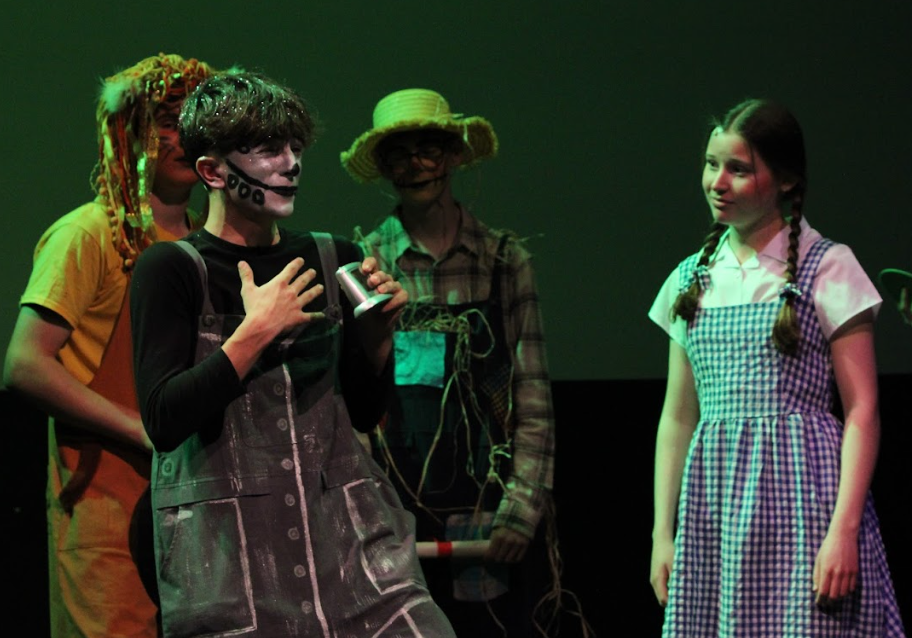
The Wizard of Oz remains a seminal piece of musical theatre, offering a timeless narrative of self-discovery, and a wonderful story to set before an audience of parents, teachers, and pupils. Based on the 1939 film and L. Frank Baum’s novel, the story follows Dorothy, a young girl in Depression-era Kansas who dreams of a land “Somewhere Over the Rainbow” where there is no more trouble. Upon her arrival in Oz, Dorothy encounters a motley assortment of companions: a Scarecrow, a cyborg axeman, and a Forest-based creature who is yellow in more ways than one. This retelling also featured the fearsome Wicked Witch of the West, with a cheeky, meta-theatrical nod to the alternative history of Wicked’s Elphaba at the outset. Thanks to some help from Good Witch Glinda and a pair of ruby slippers, but not from the duplicitous Wizard with his political promises, Dorothy eventually ends up back in Kansas with her faithful pooch Toto, having learnt that “there’s no place like home”.
The narrative was articulated with clarity, supported by an inventive lighting plot and a seamless array of sound cues. Lauren and Emma led the choreography with a keen eye for formation; their work was particularly effective during “The Jitterbug,” a complex ensemble number staged with impressive synchronicity. The directorial vision, spearheaded by Evie and Elva with support from Eloise and Roxy, resulted in a strikingly coherent narrative. It was evident that this creative team thrived on collaboration, a quality that reflects exceptionally well on the school’s ethos.
Technical leadership was provided by Jasper, whose sophisticated oversight was bolstered by Henry’s inventive lighting and the crisp sound design of Alex and Jack. There was an intelligent use of amplification for key songs and moments, which helped make those moments stand out within the narrative. Visually, the production was highly effective, particularly the decision to maintain a monochrome aesthetic reminiscent of the film through costuming and make-up during the Kansas prologue.
Onstage, the Garland cast delivered performances brimming with likability and charm. I have no doubt that the alternate Grande cast also offered similarly fantastic performances. Isabella anchored the production as Dorothy, navigating the journey with poise and an engaging innocence that made her an easy protagonist to root for. In an inspired directorial choice, the role of Toto was humanised through the magic of Oz; Hugo proved to be the perfect travelling companion, portraying “man’s best friend” with a joyful, spirited energy.
As the Scarecrow, Ben was “wobblingly” perfect. He imbued the character with a charming dither, yet delivered his lines – notably the poignant observation on those who talk without brains – with sharp comedic timing and underlying intelligence. His rendition of “If I Only Had a Brain” was tuneful and beautifully delivered. Elliot provided a strong, metallic presence as the Tin Man, while Henry’s Lion struck a delightful balance between physical power and comedic “terror.” The quintet’s chemistry was palpable, further enhanced by sublime costuming, such as the thoughtful detail of Toto’s collar matching Dorothy’s iconic dress. They made for a jolly group of companions to follow along the Yellow Brick Road.
The wider company provided robust support. Kiishi’s snarlingly villainous Wicked Witch provided a formidable foil to Matilda’s ethereal and gentle Glinda. Alex and Eloise offered a sympathetic emotional anchor as Uncle Henry and Aunt Em, while Louis, Oscar, and Ethan transitioned seamlessly into their roles as the farmhand counterparts to Dorothy’s Ozzians. Magnus delivered the role of the Wizard with genuine panache; this interpretation of the “Mighty Oz” as a massive, glittering jellyfish was a bold and surreal triumph that resonated perfectly with the audience. I don’t really know why it worked but it did, perhaps because Magnus made it work! Roxy brought a mischievous “twinkle” to the Ozzian Doorman, and the supporting turns from Olivia, Eva, Penny, Freya, and Siena rounded out the world convincingly. The ensemble – comprising Munchkins, Forest Lights, and Jitterbugs – performed with infectious gusto, providing a rich, energetic backdrop to the primary action.
This was a classic story retold by pupils who embraced every facet of theatre-making with imagination and invention. While the team behind this production may have been young, their professional execution proved they certainly “weren’t green.” A lion-hearted, colourful, and thoroughly joyous success.