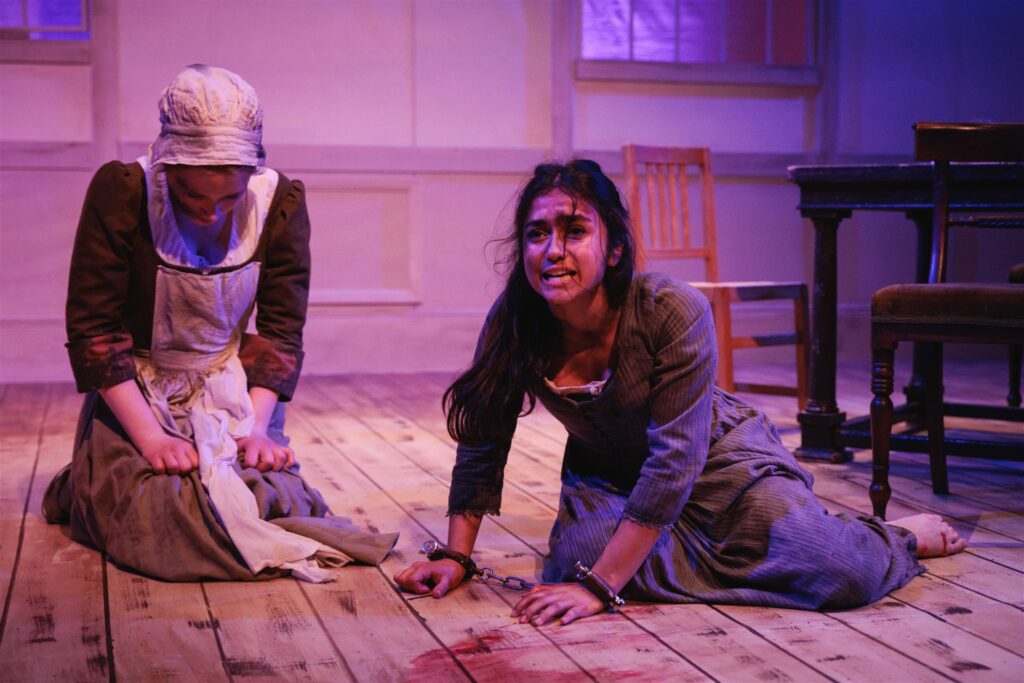
As an NSTA representative, I had the distinct pleasure of attending St Paul’s Girls’ School’s production of The Welkin by Lucy Kirkwood on Friday 13th March 2026. Under the expert guidance of Deputy Director of Drama Richard Davies, this rendition of the play held poignant relevance for a modern audience despite being set over 250 years ago. From the moment the audience entered the Celia Johnson Theatre, the atmosphere was immersive and intriguing. The pre-set gradually brought the cast on stage as they performed small domestic actions, reflecting the traditional roles of housewives of the era. There was something mesmeric about the simple act of scrubbing the floor, executed with precision.
The Welkin by Lucy Kirkwood is a gripping courtroom drama set in rural Suffolk in 18th-century England, where a group of women must decide the fate of Sally Poppy, a young woman accused of a brutal crime who will hang if found guilty. The play is not concerned with whether she committed the crime, but with experienced women determining whether she is pregnant, thus deciding her punishment. Exploring justice, prejudice, and the complexity of the female experience, it is both thought-provoking and emotionally charged. What makes the story particularly compelling is its contemporary relevance, as it reflects ongoing debates about women’s roles, sexual identity and liberation, and the often invisible labour of women.
The set design and lighting, under the vision of James Wakerell, effectively captured both the domestic and stark nature of the courtroom, with three striking arched windows and a large wooden table centre stage. From the start, there was a strong sense of energy as the audience was introduced to the main characters and the details of the crime. The signing in at the empanelling was excellently delivered, with each character touching the book. This moment introduced not only the characters but also their distinct personalities, which made this complex group of women so engaging throughout the play.
Susie delivered a powerful and immersive performance as Sally Poppy, fully embodying the character with a fiery and furious energy. From the moment she was propelled into the courtroom, Susie demonstrated a passionate and unworldly aura. Whilst she stood still being inspected to see if she had breast milk, she stared out with a chilling defiance. Susie delivered a nuanced performance that resisted simplification, communicating through subtle facial vulnerability the weight of a fractured and painful past.
Ella delivered an excellent performance as Elizabeth Luke, her portrayal was rich in nuance, with every gesture and expression revealing a deep understanding of Elizabeth’s moral complexity. This was particularly evident in her kindness towards Sally Poppy, where her gentle tone and attentive presence conveyed genuine empathy without sentimentality. Ella also excelled in her interactions with the other jury women, subtly establishing Elizabeth’s authority as a respected midwife through composed delivery and thoughtful reactions, which enhanced the ensemble dynamic. Most striking was her handling of Elizabeth’s final dilemma, where she must choose between the law and what is right for Sally; Ella communicated this internal conflict with powerful restraint, leaving a lasting impression and elevating the emotional impact of the play with skill beyond her years.
Marilou delivered an outstanding supporting performance as Mary Middleton, which greatly enhanced the play’s emotional texture through a nuanced and authentic portrayal. She fully inhabited the role with a childlike innocence that added both charm and depth, creating a character that felt vividly real while providing moments of levity within the narrative. Her excellent comic timing stood out, particularly in her earnest comments about her husband Amos and her urgency about gathering the leeks before daylight runs out, which were delivered with natural ease and precision.
Poppy was compelling as Judith Brewer, convincingly embodying a middle-aged woman experiencing menopause, using physical details – such as frequently fanning herself and keeping her distance from the other women near the fire – to create a consistent characterisation. Her line delivery was confident and emotionally grounded, allowing moments of humour to come through naturally, particularly in her observations about men and their looks, which were handled with warmth and wit.
Other memorable members of the Jury of Matrons were Peg Carter played by Greta, Sarah Smith played by Martha and Kitty Givens played by Clare. Genevieve’s portrayal of Sarah Hollis was particularly memorable. Initially mute, she later delivered a raw and mesmeric account of her experience in the woods. Rachel also gave a highly effective performance as Emma Jenkins, using dry wit and excellent comic timing to bring the character to life. Ethan gave a strong performance as Mr Coombes, clearly communicating the importance of his role while also demonstrating effective comic timing when required to turn away and remain silent.
Under Mr Davies’s direction, the cast sustained tension and emotional authenticity throughout. The supporting cast played a vital role in bringing the world of the play to life. Notable moments included the synchronised movements during the sharing of bread, a powerful prayer sequence, the panic surrounding references to “soot and devil”, and a striking modern contrast when the cast performed a contemporary song in choral a cappella.
Staging a complex and dialogue-heavy play such as The Welkin presents clear challenges, particularly in maintaining pace and clarity. However, the cast rose to this challenge admirably, delivering lines with precision and intention. There was a strong sense of ensemble throughout, and the portrayal of collective female strength was especially powerful. The final moments provided a poignant reminder of the modern role of women, as the cast returned to the stage as contemporary figures, highlighting the constant pressures and demands they face.
This production ofThe Welkin was a gripping and highly accomplished piece of theatre. It captured the play’s emotional depth and thematic complexity, leaving a lasting impression on the audience. It prompted reflection on how truth is determined and encouraged consideration of the modern tendency to look down at devices rather than engage with the world. The parallel between ignoring reality and becoming absorbed in mobile phones was both clear and thought-provoking.