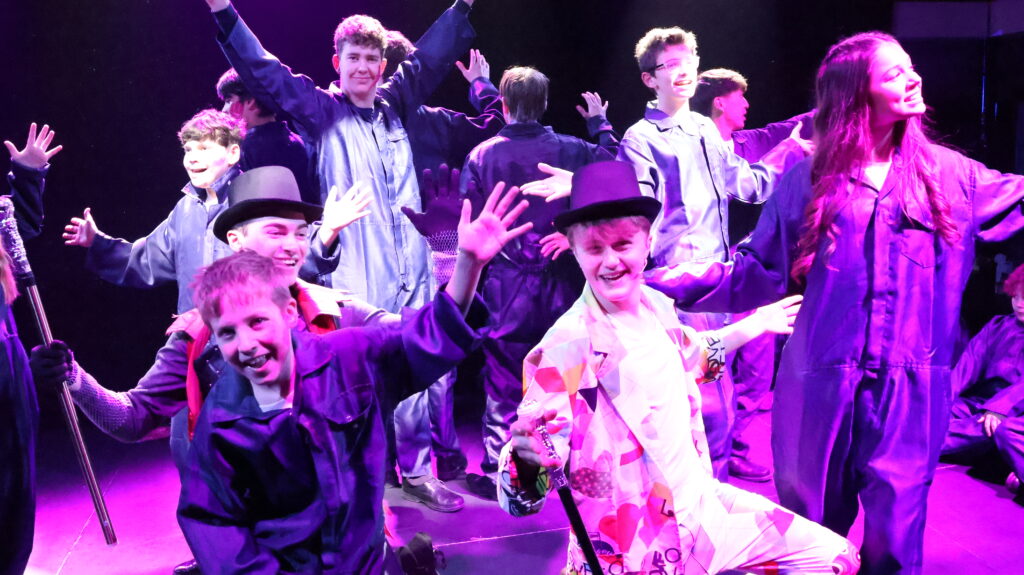
As a representative of the National School Theatre Awards, I had the pleasure of witnessing a stunning school production of Godspell at Westcliff High School for Boys on the evening of Thursday 19th March 2026. Directed by Mr Jeffreys with Musical Direction from Mr Woods, this performance of the acclaimed musical showcased the remarkable talent within the school’s theatrical community.
Originally conceived as a student project at Carnegie Mellon before debuting off-off-Broadway in 1971, Godspell is a seminal work by Stephen Schwartz and John-Michael Tebelak. Structurally unique, the musical presents a vibrant series of parables primarily drawn from the Gospel of Matthew, interspersed with music predominantly set to lyrics from traditional hymns. Its enduring cultural impact was solidified during its 1976 Broadway debut, which earned a 1977 Tony Award nomination for Best Original Score.
Staging Godspell is a perennial challenge for any school drama department; it requires a delicate balance between the high-energy antics of the first act and the sombre, inevitable gravity of the Passion in the second. Westcliff High School for Boys met this challenge head-on, delivering a production that was as intellectually stimulating as it was emotionally resonant. By leaning into a contemporary aesthetic, the ensemble all dressed in blue boiler suits, on a stage constructed in the middle of the school library, the production successfully stripped away the “flower-power” tropes often associated with the 1971 original. Instead, Westcliff High School for Boys presented a gritty, urban interpretation that felt remarkably relevant. This was not just a retelling of ancient parables, but a communal exploration of empathy, community, and the shared human experience in an increasingly fractured world.
The direction was notably sharp, utilising the entire stage to create a sense of frantic, kinetic energy. The tribal nature of the cast was established early on. The transition from a group of disparate individuals to a unified community was handled with nuance, allowing the audience to see the outstanding ensemble’s growth in real time.
What stood out to me the most was the ensemble’s discipline. The whole cast maintained a high level of intentionality. Every bit of stage business, from the slapstick humour of the Pharisees to the synchronised choreography, felt rehearsed and purposeful. The chemistry between the performers was palpable, creating a supportive environment that allowed the soloists to shine without ever overshadowing the collective effort.
The role of Jesus/Ena requires a performer with both magnetic charisma and profound vulnerability. Gabriel delivered this in spades. His portrayal was grounded; he avoided the trap of being overly ethereal, instead playing a leader who was genuinely invested in his followers. His vocal performance during “Beautiful City” was a particular highlight, offering a moment of quiet, soulful reflection that anchored the show’s moral centre.
Conversely, Oliver, playing Judas/Dio provided the necessary friction. The relationship between the two leads was the emotional heartbeat of the play. The shift from the joyful camaraderie of “All for the Best”, to the devastating betrayal in the Garden of Gethsemane was executed with professional-grade maturity.
The supporting soloists were equally impressive. Each parable leader brought a distinct personality to their segment. Conor performed “We Beseech Thee” very well indeed, bringing a massive burst of energy and charisma that had the whole audience hooked from the very first note. William’s rendition of “Light of the World” was another highlight, showing impressive versatility as he balanced a steady, upbeat guitar accompaniment with a vocal delivery that kept the song’s bright energy alive. Emma’s performance of “Day by Day” was truly stunning, capturing the song’s prayerful innocence with a crystal-clear vocal purity that held the entire auditorium in a moment of rapt silence.
From a technical standpoint, the production was extremely effective. The lighting design by Liam played a crucial role in the shift from the playground atmosphere of Act One to the Passion of Act Two. The use of harsh, industrial angles and a starker colour palette in the final scenes underscored the shift in stakes, particularly the use of the green wash in the Gethsemane scene.
The live band deserves a special mention for their exceptional contribution to the production’s energy. Under tight musical direction, the band provided a vibrant, rock-infused backdrop that perfectly complemented the vocal performances. The acoustic balance between the pit and the stage was expertly maintained throughout, ensuring that every nuance of the intricate harmonies in Schwartz’s score was delivered with absolute clarity. This seamless integration allowed the cast’s lyrical storytelling to shine, supported by a rich and perfectly poised instrumental foundation.
Ultimately, this production was a sophisticated, energetic, and deeply moving piece of theatre that showcased the very best of what school drama can achieve: a collaborative, transformative experience for performers and audience alike. The company demonstrated an artistic maturity that far exceeded their years, navigating the complexities of the score and the nuances of the narrative with both precision and heart.