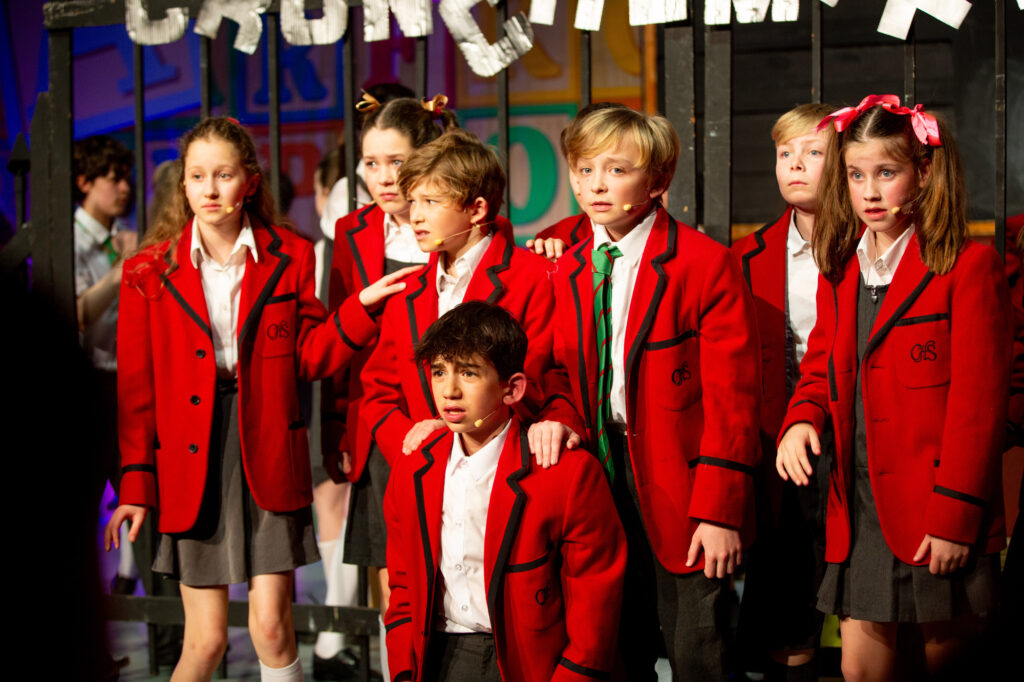
As an NSTA representative, I had the honour of attending the closing night of Cumnor House Prep School’s Year 7 production of Matilda on Friday 20th March 2026. Under the direction of Charley Harris, with musical direction from Rob Cousins and the support of the wider team, the pupils were clearly inspired to perform with confidence and enthusiasm.
Based on Roald Dahl’s beloved novel, with a book by Dennis Kelly and music and lyrics by Tim Minchin, Matilda Jr. is a vibrant, condensed version of the multi-award-winning stage hit, which won seven 2012 Olivier Awards, including Best New Musical, and four 2013 Tony Awards, including Best Book of a Musical. It tells the story of Matilda Wormwood, a clever and imaginative young girl who refuses to be held back by her uncaring parents or the tyrannical Miss Trunchbull.
From the moment I stepped into the theatre, greeted by Tim Freeman’s inventive set design and the palpable buzz of a packed audience, it was clear this would be a special evening. The frame of the playground swing upstage right and the versatile alphabet blocks hinted at the creativity to come, and the production more than delivered on that promise.
From the outset, the pupils’ excitement was unmistakable. The energy was immediate and infectious, beginning with the first soloist in “Miracle”. Every performer gave their all, demonstrating impressive vocal strength, clarity, and control for such a young cast. The ensemble’s entrance, filling both aisles and stage, was particularly striking: the volume of the singing, combined with precise, confident choreography, was remarkable. Each pupil performed with complete assurance and joy, beaming throughout.
The standard established in the opening number continued seamlessly, not least in the handling of set changes. The decision for the cast to manage these transitions themselves proved highly effective. Movements were executed calmly and efficiently, with each pupil clearly aware of their role. Even in semi-darkness, their focus never wavered, always maintaining the integrity of the performance.
The introduction of the Wormwood family brought a shift in tone and an immediate injection of comedy. As Mr Wormwood, Orlando demonstrated excellent comic timing, supported by strong physicality and a well-sustained accent that captured the character’s dubious nature. His performance remained composed and engaging throughout, even when a minor costume mishap threatened to disrupt proceedings. Chloe’s Mrs Wormwood was equally memorable. From her first entrance, striding confidently in high heels, she fully embodied the character’s flamboyance. Supported by bold make-up from the Year 8 pupil make up team, her performance was consistently animated and detailed. She maintained characterisation even when leaving the stage, committing fully to every moment and drawing frequent laughter and applause from the audience. Tom, as Michael, complemented this dynamic with a series of well-delivered comedic lines, highlighting Matilda’s isolation within her family.
Mabel delivered a sensitive and compelling portrayal of Matilda. She captured the character’s resilience and intelligence with ease, presenting a convincing and engaging protagonist. Her performance of “Naughty” was confident and fluid, with a strong physical commitment to the choreography. However, it was in “Quiet” that her performance truly resonated; her control and emotional depth created a genuinely moving moment.
The transition into the school setting introduced warmth through Teddy’s portrayal of Miss Honey, characterised by kindness and sincerity. Ruby’s Miss Phelps shared this gentle presence, and together they demonstrated the profound impact of supportive adults. The decision to present “My House” as a duet was particularly effective, the harmonies adding emotional weight and reinforcing the sense of unity in protecting Matilda.
In contrast, Ollie’s Miss Trunchbull provided a commanding and highly entertaining presence. His initial introduction – voice only, facing upstage – created a strong sense of anticipation, which was fully realised with the dramatic reveal. From that moment, he embodied the role with confidence, balancing menace and humour with impressive skill. His performances of “The Hammer” and “The Smell of Rebellion” were highlights, eliciting both laughter and awe from the audience, especially in those high heels and make-up!
The ensemble of schoolchildren played a vital role in sustaining the production’s energy and narrative clarity. Freya’s Lavender stood out for her vibrant stage presence and commitment, particularly during “When I Grow Up”, where her confident singing and fearless physicality on the swings were commendable. Across the ensemble, pupils embraced their individual moments, whether through character-led comedy or focused storytelling, contributing to a cohesive and dynamic whole. Numbers such as “School Song”, “Bruce” and “Revolting Children” showcased both their enthusiasm and their precision, with every lyric and movement executed with clarity and intent.
The technical elements of the production were equally impressive. Barney’s lighting design was both thoughtful and effective, clearly defining locations and enhancing the storytelling through colour and focus. The use of distinct areas, such as the green tones for the Wormwoods and the red hues for the poignant acrobat sequences, added visual clarity and emotional depth. That Barney both designed and operated the lighting is a notable achievement, particularly given the complexity and number of cues involved.
Overall, this was an outstanding production, reflecting an extraordinary level of commitment from both cast and crew. It was evident that every pupil took great pride in their contribution, resulting in a performance that was both polished and full of genuine joy. Above all, the production captured the heart of Matilda. Its message – that when young people are nurtured with kindness, respect and patience, they are capable of remarkable things – was not only conveyed on stage but was clearly embedded in the rehearsal process itself. This was, without doubt, a celebration of creativity, collaboration and the transformative power of theatre. One might even call it a “Miracle”!