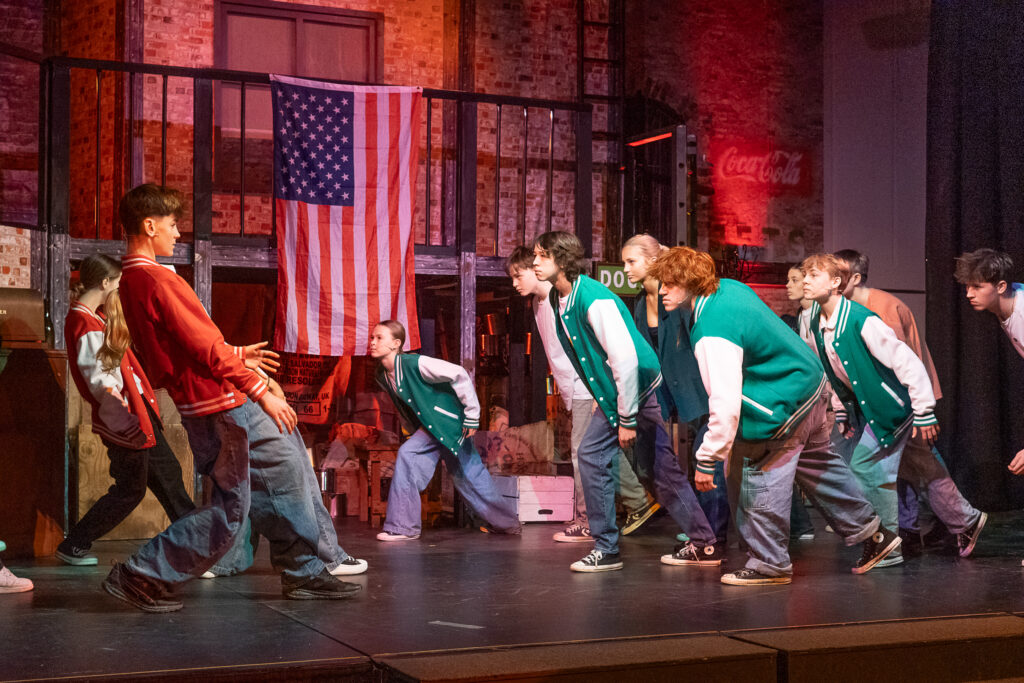
As an NSTA representative, I was delighted to attend Sibford School’s production of West Side Story on Tuesday 3rd March 2026. Director Mr Madden and Musical Director Mrs Hudson’s passion for this production was evident from that programme notes; they clearly embraced its profound place in the musical theatre canon and its enduring social relevance for their pupils.
West Side Story is a musical conceived by Jerome Robbins with music by Leonard Bernstein and lyrics by Stephen Sondheim. It reimagines Romeo and Juliet in 1950s Manhattan, following the rivalry between two teenage street gangs – the Sharks and the Jets – and the doomed love story of Tony, a former Jet, and Maria, the sister of the Sharks’ leader. The original 1957 Broadway production earned two Tony Awards.
Anticipation was high on opening night, heightened by the clever staging. The thrust configuration meant the audience were somewhat distanced from the stage set, a striking labyrinth of industrial levels representing the Upper West Side tenement blocks. Deliberately cluttered and chaotic, it was inevitable that the action, including the violence, would spill onto floor level and bring the audience up close to the tension in the gym and in the streets. At the start, however, the floor was empty and the tenements had an eerie stillness, seen through a well‑designed scrim. The ethereal distortion of the view, moodily lit with a red wash and with the legend “New York City, Upper West Side, Hell’s Kitchen, PR Territory, 1961” projected onto the gauze, set the tone immediately. This atmosphere was amplified by Mrs Hudson’s impressively large ensemble being quite literally caged in on the third side of the thrust behind ominous metal fencing. The atmosphere was expectant, and the start of the show did not disappoint.
As the ensemble entered individually and in small groups to build up the iconic prologue, Miss Swan’s choreography immediately captivated the audience. While it included many iconic motifs from the Robbins original, the movement had been crafted uniquely for Sibford’s cast and for their space. These young performers hit exactly the right stylistic notes and the prologue – and indeed the production as a whole – was characterised by their energy and athleticism. There was focus and menace in all the dance numbers; laser precision combined with expressive quality. Harry as Chino and Oscar as Action particularly stood out in this respect. Their casual agility epitomised the febrile nervous energy and belligerent prejudices that fuel the narrative. The addition of a haunting a cappella Puerto Rican anthem drew us further into the context, and from then on the production was driven by compelling performances.
Theo’s Riff was commanding, never missing a beat, effortlessly rhythmic and a superb contrast to the easy charm of Joseph’s Tony. The build up to the gym sequence was excellent and the ensemble work was impressive. This was a large cast, yet the transition into that important whole‑company number was seamless. The tension between Bernado and Riff was beautifully sustained, counterpointing Anita’s combination of flirtatiousness and disdain, while interactions between Rafael’s Bernardo and Bonnie as Anita were another highlight.
When Tony and Maria finally met, Evie truly came into her own as the story’s heroine. It takes great maturity to play a character’s innocence without artifice, but the simplicity and sincerity of her smile across the dance floor captured the audience’s hearts, let alone Tony’s. The partnering skills shown by Joseph and Evie were superb. It is a challenge for young performers to tackle such an emotionally intense pairing, especially while navigating the vocal demands of the roles, and Mr Madden’s direction was powerfully sensitive. There was no awkward intimacy. They simply never took their eyes off each other, a simple trick that dance partners know all too well and one that worked to perfection in drawing us into their doomed love affair.
As bitterness, mistrust and Tony’s misplaced optimism propelled us towards the Act One finale and the legendary “Rumble”, Evie’s vulnerable vibrato in her exquisite top register and Joseph’s playful quality with the mannequins gave “One Hand, One Heart” a sincerity not often achieved by school productions. When Tony attempted to intervene in “The Rumble”, already dominated skilfully by Theo and Rafael’s exceptional ensemble leadership, the inevitability of tragedy had been well prepared. Excellent choreography shaped a high‑energy fight sequence that amplified the stillness left behind by Riff’s and Bernado’s bodies.
Act Two opened with the beautiful ensemble harmonies of “I Feel Pretty”. Equally beautiful was the ensemble arrangement of “Somewhere”. This surprising twist on a familiar piece worked extremely well, particularly in providing a vocal showcase for Anybodys, played by Belle, who had already caught the eye with her characterisation and excellent ensemble dance skills.
There was further delightful ensemble work in “Gee, Officer Krupke”, always a crowd‑pleaser but particularly effective here with the slick bench‑stacking transitions and Oscar’s aggressive acrobatics. Heidi and Oliver, as Baby John and A‑Rab respectively, led the comedic relief in a sequence full of humour. Although not part of this scene, the earlier characterisation of the police officers had been strong enough for the satire to land effectively. Pepper, in particular, was a compelling Lieutenant Schrank. Her low register and judicious use of pauses created an intimidating presence in the police scenes, ably supported by Thomas’s Officer Krupke.
As we neared the denouement, the emotion became overwhelming. “A Boy Like That/I Have a Love” was heartbreaking. Evie was as mesmerising as ever as Maria, while Anita’s intensity was truly captivating. Bonnie’s dance skills had already been very much in evidence, but the flamboyant Latin rhythms of the gym dance and “America” showcased her talents beautifully. The raw emotion she brought to the aftermath of Bernado’s death was superb, and this carried into the subsequent drugstore scene. Her reactions to being cornered and circled like a bullfighting sequence captured both the terror and anger that lead to her fateful false statement about Maria. Bonnie’s intensity in the second act allowed other ensemble roles to shine. Doc’s outburst, for example, after rescuing Anita and having to deal with a naive Tony, had real passion and energy behind it.
Although very few in the audience will have been unaware of how the story ends, the finale was still deeply poignant. Once again, Evie’s emotional maturity was evident as Maria stood her ground, protecting Tony’s body and – even after he had been carried off – standing strong alone on stage.
Sibford School’s West Side Story was a nerve‑tingling spectacle. This was a powerfully crafted show; even the curtain calls were eye‑catching, with each performer’s bows being individually customised. It was testament to the sense of ownership that Mr Madden and Mrs Hudson had instilled in this large cast for their characters, and to the degree to which they had embraced this unique opportunity to stage a true gem of musical theatre heritage.