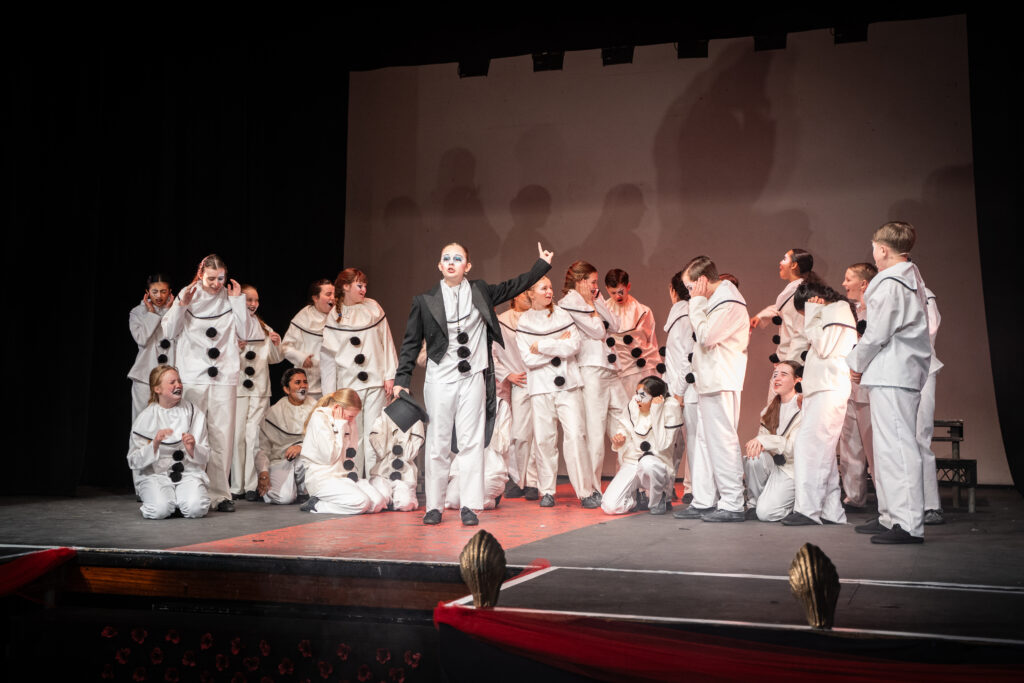
As an NSTA representative, I had the honour of attending Trent College’s production of Oh, What a Lovely War! on Thursday 26th March 2026. From the outset, this was a production that demonstrated both ambition and sensitivity, tackling a complex and emotionally charged piece of theatre with remarkable maturity. Director Donnaleigh Ward should be immensely proud, especially given the last-minute additional challenge of stepping into a role due to pupil illness. Her professionalism and commitment were admirable and highlighted the resilience required in live theatre.
Oh, What a Lovely War! is a satirical and thought-provoking musical that explores the events and attitudes surrounding the First World War. Created by Joan Littlewood and Theatre Workshop, the piece blends music hall-style songs, sharp political commentary, and historical facts to present the war from the perspective of ordinary soldiers. Performed in a Pierrot-style setting, the musical contrasts the initial patriotic enthusiasm with the devastating realities of trench warfare, exposing the human cost of political decisions. Through humour, irony, and poignancy, it encourages audiences to reflect on the true impact of war.
This musical feels especially relevant in today’s global climate, and the production did not shy away from this. The minimal yet highly effective staging allowed the storytelling to remain at the forefront while still creating a visually engaging performance space. It allowed fluid transitions between scenes while maintaining focus on the performers and their message. The use of Union Jack flags and carefully placed poppies immediately grounded the audience in the historical context, serving as a powerful visual reminder of remembrance. The integration of projected statistics and historical imagery throughout added depth and poignancy, reinforcing the stark realities behind the satire.
The standard of performance across the cast was consistently high. From early on, during “Row Row Row”, it was clear that the cast possessed both talent and energy. The number set the tone effectively, combining humour with underlying tension. The opening act established a strong foundation, with the audience quickly recognising the quality of performance on display.
Every performer demonstrated strong physicality, expressive facial work, and clear characterisation. Jack delivered a particularly memorable performance, especially during “Heilige Nacht (Silent Night)” which was both haunting and deeply moving. His vocal clarity, emotional connection, and sustained energy throughout the production were exceptional, and at times it was easy to forget that Jack was not a professional performer. Hugo, portraying Haig, brought authority and presence to the role, with strong vocal projection and clear diction that ensured every line carried weight.
Summer, as the Master of Ceremonies, was exceptional. Her narration was clear, confident, and engaging, guiding the audience seamlessly through the episodic structure of the production. She used the performance space with impressive assurance, frequently breaking the fourth wall in a way that felt entirely in keeping with the Brechtian style. Her comic timing and stage presence were outstanding, particularly during the “War Games” sequences, which cleverly balanced audience interaction with the darker themes of the piece.
Together, the principal performers helped anchor the production, while the ensemble brought it vividly to life: the ensemble work was a standout feature of the production. Numbers such as “Belgium Put the Kibosh on the Kaiser” and “Oh, It’s a Lovely War!” were delivered with precision and energy, showcasing tight choreography and strong vocal harmonies. The choreography, led by Joy, was particularly impressive given the scale and complexity of the routines.
One of the most powerful moments came during “Gassed Last Night”. The use of green lighting and smoke effects created an unsettling and immersive experience, allowing the audience to viscerally understand the horrors faced by soldiers. It was uncomfortable viewing, but necessarily so. The suffragette scene and the inclusion of Irish soldiers added important historical context, reminding the audience of the broader social and political landscape of the time. These moments were handled with care and respect, contributing to the production’s educational value.
The interactive elements, such as inviting the audience to throw rubber chickens or attempt a challenging tongue twister, brought humour and accessibility to the performance while cleverly juxtaposing the gravity of war.
Other notable musical highlights included “When This Lousy War is Over”, “Pack Up Your Troubles” and “Keep the Home Fires Burning”, all performed with emotional depth and musical precision. The staging of “They Were Only Playing Leapfrog” was particularly striking, combining movement and symbolism to powerful effect. The final number, “I Don’t Want to Be a Soldier / They Didn’t Believe Me” was a fitting conclusion: poignant, reflective, and deeply moving.
The technical team played a vital role in the success of the evening. Oscar and Ali delivered excellent lighting design, while Emerson and Martha ensured sound was clear and impactful throughout. Maisie and Poppy’s work on hair and make-up was exceptional, helping to create a visually cohesive ensemble. The backstage team: Ben, Natalie, Toby, Ruaraidh, and Lizzie – led by school technician and former pupil Albi – worked tirelessly to ensure smooth transitions. Kathryn’s costume support was outstanding; the costumes were truly impressive and must have taken considerable time and care to source and create. Special recognition must also go to the musicians, Ben and Louis, whose contributions elevated the production. Louis’s on-stage performance of “The Last Post” was particularly moving, offering a poignant moment of reflection for the audience.
This was a thoughtful and impactful piece of theatre. The combination of strong performances, effective staging, and meaningful storytelling created a production that resonated deeply with its audience. The use of physical theatre, ensemble work, and historical context ensured that the performance remained engaging while honouring the gravity of its subject matter. It not only entertained, but also educated and provoked reflection, reminding us of the sacrifices made by previous generations.
School productions like this deserve to be celebrated and supported. Trent College has clearly fostered an environment where pupils can explore challenging material with confidence and sensitivity. Oh, What a Lovely War! was a moving, memorable, and highly accomplished performance, and one that will stay with its audience long after the final bow.